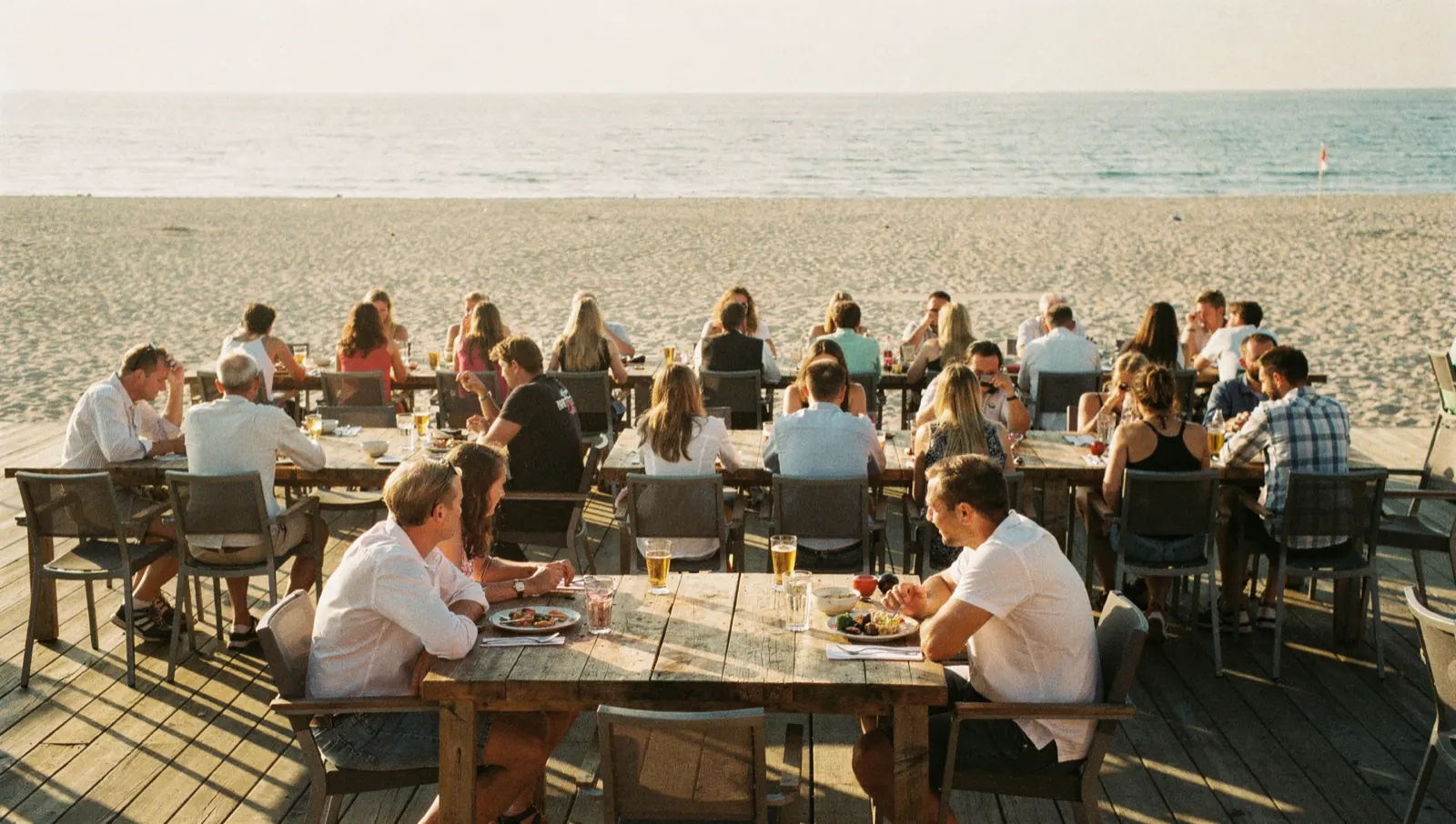
Three hundred messages a week, and you read every one
Bookings arrive by WhatsApp, by Instagram, on the landline and through the form on your site. Somebody types out every answer again, in the middle of a service, and the only person who knows what Saturday looks like is that somebody.


Onebookingisthirtysecondsofwork.Threehundredbookingsarehalfaworkingweek,everyweek.
How does a beach bar get its bookings out of WhatsApp?
Nivora builds a booking system your guest uses directly, through your own site or an app on their phone, with a waiting list when you are full and a reminder twenty four hours and two hours before they arrive. What comes in today as three to four hundred loose messages a week stands there instead as one list per day: confirmed, waiting, cancelled. The guest can see their own status without having to message you again, and you read a list rather than a chat window.
A regular sets up an account once and books in twenty seconds the time after. Somebody who has never been fills in the same four things they would have typed into a message anyway: which day, how many people, what time, and anything you need to know beforehand.
WhatsApp does not close. Whoever would rather send a message still sends a message, and it lands in the same list instead of in a separate window. The difference is that the reply is already prepared, with your own hours and your own house rules in it, and someone on your team presses send.
Where those hours actually go
Every message is small. Somebody asks whether there is still room for four on Saturday at seven. You check in your head or on a sheet, you type back, they answer half an hour later, you type again. Three minutes, and then the next one.
None of it sits together. Saturday's bookings are spread over a chat window, a notebook, two Instagram conversations and an email. Anyone who wants to know on Saturday morning how many people are coming has to gather it all up again.
And what gets cancelled does not always get cancelled. A table that stays empty at eight is a table you will not sell again that evening, and you find out at eight.
How this is put together
The guest books it themselves
Through your site or the app, choosing from what you actually offer: a bed on the front row, a table inside, a table on the terrace. What they see is what you genuinely have free at that hour, not a general calendar that says yes to everything and leaves you to sort it out.
Full is not the same as no
When you are full they go on a waiting list instead of hearing a flat no. If somebody drops out, the first name moves up and gets a message. Today, full usually just means a guest you never hear from again, and on a coast where half your trade is passing through, that is the expensive kind of no.
Two reminders, and no nagging
One twenty four hours before, one two hours before, both with a link to cancel in a single tap. Cancelling has to be easier than not turning up, or people simply do not turn up. Nothing else goes out: your guests are on holiday and you are not a mailing list.

Other solutions for a beach bar
The rest of what we build for this trade. Each one is a separate thing you can ask for.

Who gets the bed
Regulars confirmed straight away, unfamiliar names on hold until you know. You keep the decision, the system prepares it.
See what this looks like
The day on one screen
Every booking, the places still free, who is working and the forecast per hour. One picture, behind the bar, for whoever opens the shift.
See what this looks like
Who works Saturday
Your team marks its own availability and enters its own hours after the shift. You confirm one list instead of counting fifteen messages.
See what this looks like
How busy it gets
One sheet every evening for the day after tomorrow, out of your own till, the weather and the tide, with an honest monthly score.
See what this looks likeDoes this sound familiar?
If two or more of these land, there is almost certainly something to gain.
- Your bookings live in a chat window on your own phone
- On Saturday morning somebody pieces together who is coming
- When you are full you say no, and you never hear from that guest again
- A table stays empty without anyone having cancelled it
What we are not going to claim
We are not going to say booking software does not exist. Formitable, Zenchef, Resengo, TheFork and SevenRooms all sell it, and if you have a normal table plan and you are happy with it, we will say so at the first meeting. This is built for the business where beds, tables, groups and a waiting list run through each other and where all of it goes by message today.
We are not going to put a percentage on no-shows. A reminder demonstrably helps, but how much it helps at your place is something we only know once we have measured it at your place. You get the count of what came in, what was confirmed and who did not turn up, from the first week, and you can judge it yourself after a month.
And we are not going to say the phone stops ringing. A group of twenty with a birthday in it will call, and should call. What changes is that the eighty small ones no longer need you.

Stop worrying about AI
We weigh up what AI can genuinely do for a business like yours, cut through the noise, and keep you posted on what actually matters. You stay in the loop, without the hype.
Questions, answered
The things people usually want to know before they reach out.
No. Booking runs through a link on your site or in your Instagram bio, in the browser, with nothing to install and no account needed. The app exists for the guest who comes back often and would rather not fill in the same details every time, and for the guest who wants to see their own status without messaging you. Most people never install it and that is fine.
Still have a question?
Visit the Help CenterSend us one weekend of messages
One Saturday and one Sunday exactly as they came in: the messages, the calls, the form. We count how many there really were, how many were the same person twice, and how many could have been answered without you. You get that back before anything is agreed or signed.